Technical Guides
How to Replace a Secure Email Gateway Without Breaking Mail Flow
Replace your secure email gateway with no MX change. A parallel-run migration plan: pilot design, stakeholder buy-in, and the metrics that prove it worked.

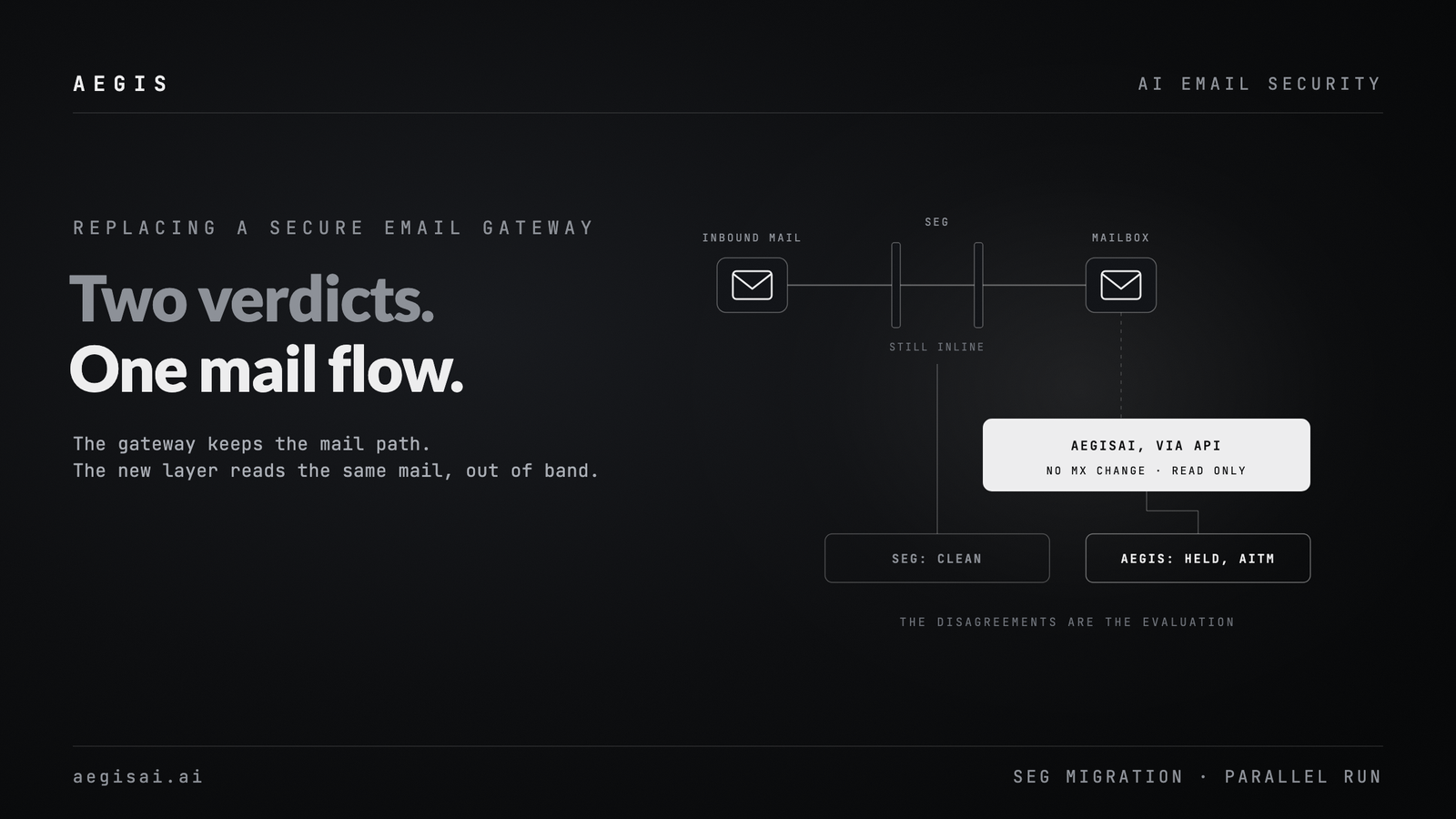

Replacing a Secure Email Gateway does not require a cutover weekend. The safe path runs the new detection layer alongside the existing SEG for two to four weeks, compares what each one catches on real production mail, and retires the SEG in stages tied to measured results rather than a date on the calendar. This guide covers how to plan that migration, who needs to sign off, what quietly breaks, and how to prove the switch was worth making.
A Secure Email Gateway is inline mail infrastructure. Traffic is routed through it with an MX record change, so every inbound message physically passes through the gateway before it reaches the mailbox. Detection is built on rules, signatures, and domain or IP reputation checked against threat feeds.
An API-based detection layer works differently. It connects to Microsoft 365 or Google Workspace through the platform API and never becomes part of the mail routing path. It reads message content, headers, and context after the mailbox provider has delivered the mail, and it can quarantine, label, alert, or remove without sitting in line for delivery. That architectural difference is what makes the migration low risk: you do not have to touch DNS or mail flow to run a second layer of detection next to your SEG.
| Secure Email Gateway | API-based AI-native detection | |
|---|---|---|
| Integration point | Inline, via an MX record change | Direct API to Microsoft 365 or Google Workspace |
| Detection basis | Rules, signatures, sender reputation, threat feeds | Reasoning about the request, the identity, the sending infrastructure, and the thread |
| Novel attacks | The threat generally has to be seen somewhere first | Judged on first sighting, with no learning period |
| Deployment time | Days to weeks, including DNS propagation and mail flow testing | Minutes |
| Maintenance | Ongoing rule writing and exception management | Little to no manual tuning |
| Cutover risk | High, because mail delivery depends on correct DNS config | Low, because it runs in monitor-only mode beside the existing SEG |
Secure Email Gateways were built for a threat model that no longer matches what lands in the inbox. They inspect mail with static rules, signatures, sender reputation, and known-bad indicators: domain blocklists, malware hashes, known phishing kits. That works against attacks someone has already seen. It does not work against attacks that have never existed before.
Modern phishing and Business Email Compromise skip most of what a SEG is built to catch. No-payload phishing carries no malicious link or attachment to scan, just a plausible request from a spoofed or compromised account. Adversary-in-the-Middle kits proxy a real login page in real time, so there is no bad domain to flag until the credentials and the session cookie are already gone. AI-generated spear phishing produces clean, context-aware messages that do not trip language heuristics tuned on older and sloppier attacks.
The numbers on that last point are worse than most teams assume. AegisAI research in The State of the AI Threat in Email found that AI-generated spear phishing bypassed Gmail and Microsoft filters 50.3% of the time, against 28.5% for human-written phishing, and that 72.6% of the AI spear phishing that got through passed DMARC authentication. Authentication is not the control people think it is when the attacker is sending from a compromised legitimate account.
Operational cost compounds the detection gap. SEGs accumulate rule sprawl. Every near miss or executive complaint produces a new exception, exceptions pile up, and eventually nobody on the team can say why a given rule exists. Analysts who should be investigating real BEC attempts spend their week retuning filters and clearing false positives instead.
No. An API-based platform connects through the Microsoft 365 or Google Workspace API, so it needs no MX record change to start inspecting mail and no MX record change to start taking action. Mail routing stays exactly as it is today.
You only touch DNS if you are also retiring the SEG relay itself at the end of the project, and even then it is the last step, after enforcement has already been validated through the API. Many organizations finish a SEG replacement without editing a DNS record at all.
Run in parallel. This is the single most important decision in the migration and the one most guides skip.
Because an API-based platform needs no MX change, you can deploy it in monitor-only mode while the SEG remains the system of record for mail flow. It reads the same traffic, scores the same messages, and produces its own verdicts without taking any blocking action. That gives you a live side-by-side comparison: what the SEG caught, what the new layer caught, and where the two disagreed. A pilot that goes badly has zero effect on mail delivery, because nothing about routing changed.
Cutting the MX record over to a new inline provider on day one collapses the evaluation and the migration into one high-stakes event. If detection quality disappoints, or a legitimate business process turns out to depend on an undocumented mail flow rule, you are troubleshooting in production with executives watching.
A pilot proves nothing without a baseline. Before you deploy anything, pull 90 days of SEG data: total messages processed, messages quarantined, false-positive complaints logged with the help desk, and any known misses that surfaced downstream, such as a user reporting a phishing email that got through.
Run the pilot long enough to cover a full business cycle, including invoicing periods and monthly reporting deadlines that generate unusual mail patterns. Two weeks is the minimum and four is better. Measure the pilot cohort against the same categories as the baseline, and define what success means before you start rather than after you see numbers you like. The vendor side of that evaluation is covered separately in our guide to evaluating email security vendors.
SEG migrations fail politically more often than they fail technically. Four groups need a different conversation.
Messaging and infrastructure admins need to hear that the new platform is API-based and carries no mail flow risk during evaluation. Their real question is whether this breaks delivery, and the honest answer during a parallel run is no, because nothing about routing changes until you decide to decommission.
The SOC and the analysts running triage need side-by-side verdict comparisons early, not a rollout announcement. Buy-in comes from watching the new platform catch something the SEG missed, or from seeing their weekly false-positive queue shrink. Show them the data before you ask them to trust the tool.
Finance, executive assistants, and other high-risk roles need a plain explanation of what changes for them, which is usually nothing, plus a fast way to report anything that looks wrong.
Executive sponsors and budget owners need the case framed in what they already track: incident reduction, analyst hours reclaimed, and time to detect on novel attacks. Save the architecture discussion for the security team.
Track these before, during, and after, so the comparison is apples to apples.
Mostly by not looking like anything the gateway has a rule for. An attacker sending from a compromised but legitimate account inherits that domain's clean reputation and valid SPF, DKIM, and DMARC records, so authentication checks pass. A no-payload message contains no link or attachment to detonate. An AiTM kit puts the malicious step behind a redirect chain that resolves only after delivery. Our threat intelligence team walked through the specific techniques in how to bypass a secure email gateway.
The common thread is that none of these require infrastructure the SEG has previously flagged as bad, which is the category of threat the rule-and-reputation model is structurally built to miss.
Third-party dependencies on the mail relay get missed. Marketing platforms, CRM plugins, DLP scanners, and archiving tools sometimes route through the SEG relay path, not just user-facing mail. Audit every system that touches mail flow before decommissioning, not just the ones the security team owns. This is also a good moment to look for unsanctioned integrations and OAuth grants connected to the mailbox years ago that nobody remembers until they break.
The rollback plan does not exist until it is needed. Keep the SEG configuration exportable and its DNS records ready to restore for at least 90 days after decommissioning. A migration with no documented rollback threshold turns any post-cutover incident into an emergency instead of a contingency.
Compliance and legal holds get overlooked. If the SEG performs archiving, retention, or e-discovery functions beyond threat detection, confirm that the replacement or a separate archiving tool covers that requirement before cutover, not after an audit asks.
The project is scoped as an IT ticket instead of a change-management effort. The technical migration is the easy part when you use an API-based platform and run in parallel. Stakeholder alignment, metric definitions, and a staged decommissioning plan are what decide whether the switch is smooth or painful.
AegisAI is built for the parallel run described above. It connects to Microsoft 365 and Google Workspace by API, deploys in minutes, and requires no MX record change, so you can run it beside your existing SEG from day one and compare verdicts before making any enforcement decision. Its agents reason about the request, the identity behind it, the sending infrastructure, and the thread it claims to belong to, from the first message and with no learning period, which is what lets it catch no-payload phishing, AiTM, and AI-generated BEC that rule-based gateways are built to miss.
Customers typically see up to 90% fewer false positives compared with legacy filters, with automated investigation and response cutting manual triage load on the SOC. AegisAI is SOC 2 Type II certified, encrypts data in transit and at rest, and never stores full email content beyond what analysis requires. Every verdict comes with a readable reason rather than a score. You can see the architecture comparison on our secure email gateway alternative page, or the detection detail on inbound email security.
How long should a SEG parallel run last?
Two weeks is the minimum and four is better. The run needs to cover at least one full business cycle, including invoicing and month-end reporting, or the baseline misses your noisiest mail patterns.
Can I keep my SEG and add an API layer permanently?
Yes, and some organizations do, usually where the SEG also handles archiving or outbound DLP. The question to answer during the parallel run is whether the SEG is still catching anything the API layer does not, and what you are paying for that delta.
What happens to my existing SEG rules and exceptions?
Most of them do not transfer, and that is the point. Rules and exceptions are the maintenance burden you are trying to shed. Export them, keep the export for 90 days, and treat any rule you actually need to recreate as a signal worth investigating.
Will users notice the migration?
A well-run migration is invisible to end users. Mail routing does not change during the parallel run, and quarantine behavior only changes for a cohort once you deliberately move that cohort to enforcement.
How do I prove the new platform is better rather than just different?
Novel-attack detection is the metric that answers this. Count incidents caught that had no signature or reputation match in the SEG rule set. Catch-rate parity on known-bad mail proves you did not regress; novel-attack detection proves you gained something.
Pull your SEG baseline data this week, before you evaluate any replacement. It is the most useful artifact in every conversation that follows, from stakeholder buy-in to proving the business case at the end.
If you want to see how an API-based layer performs against your own mail in monitor-only mode, book a demo and we will set up a read-only parallel run.