Technical Guides
How AI-Powered Email Security Works (and Where It Beats Traditional Filters)
How AI-native email security detects phishing, BEC, AiTM and zero-day attacks that rule-based filters miss, plus a checklist for verifying vendor claims.


Last updated: September 14, 2026
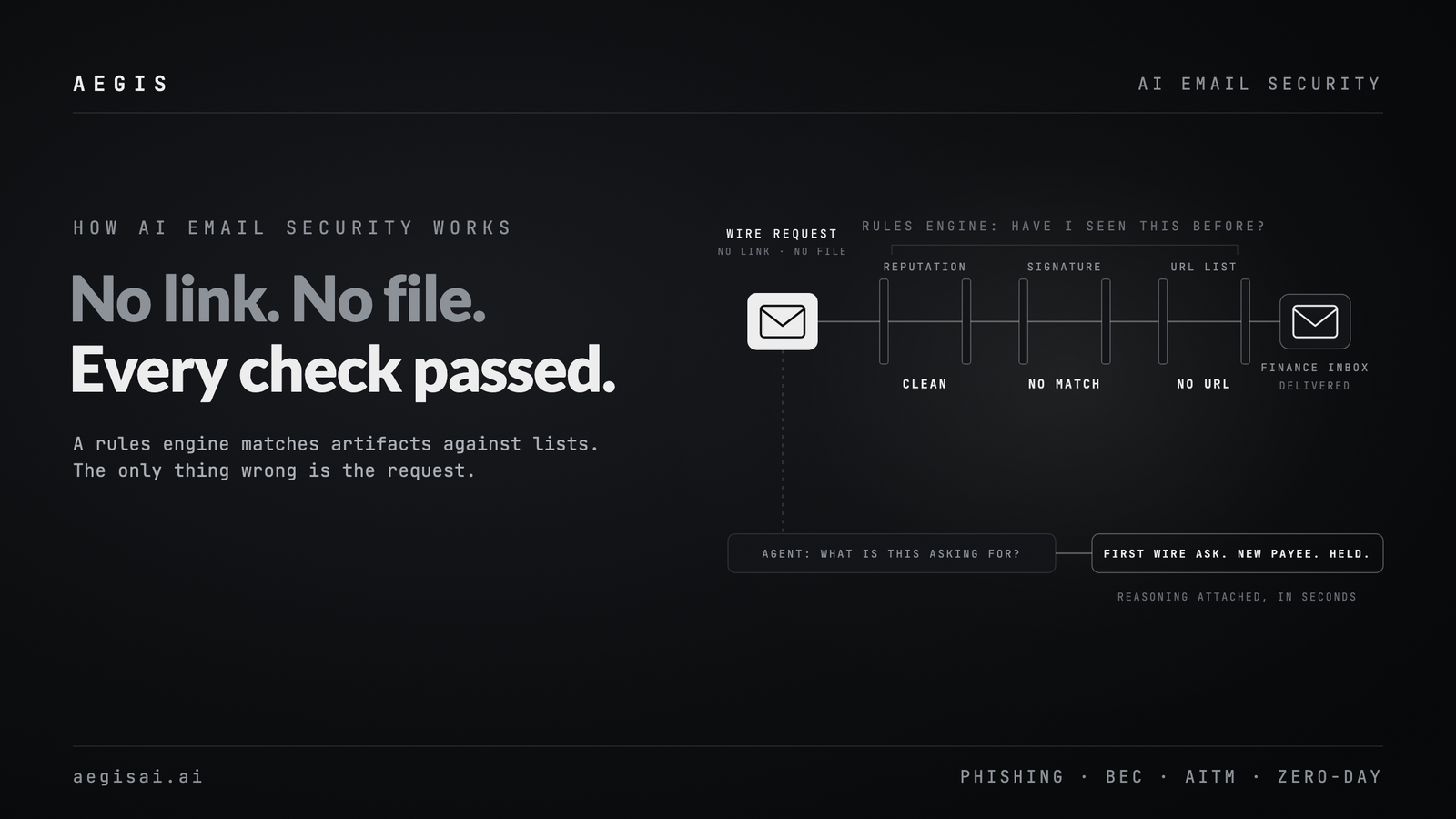
AI-powered email security replaces static rules with reasoning. A rules engine matches each message against things it has already seen: known-bad domains, malicious file signatures, flagged URLs, keyword lists. An AI-native system reads the message the way an analyst would. It works out what the message is asking the recipient to do, whether the claimed sender and the sending infrastructure agree, whether the thread supports the request, and what the authentication results prove. Then it produces a judgment, with the reasoning attached. That difference is why a brand-new domain, a first-time wire request, or a perfectly written BEC email with no link and no attachment passes a rules engine untouched and gets caught by a system that reasons.
Most vendors now have the word AI somewhere on their site. The distinction that matters is whether AI is the detection engine or a feature added to a rules-based core.
AI-assisted systems still run on signatures, blocklists, and reputation databases. Machine learning gets layered on top to score attachments or catch spam variants, but the primary decision is still a lookup: does this match something we already know is bad? When it does not match, the email passes.
AI-native systems reason about each email on its own terms. Agents evaluate the request, the language, the relationship between sender and recipient, and the infrastructure behind the message, then produce a verdict rather than a match result. A system that needs a threat-feed update to catch a new attack pattern is AI-assisted. A system that catches the pattern the first time, because the reasoning never depended on having seen it before, is AI-native.
The practical test is one question. Ask the vendor what happens when an attack uses a domain registered yesterday, matches a real executive's tone, and contains no link and no attachment. If the answer involves reputation checks, blocklists, or a learning period before detection is reliable, the product is AI-assisted. If the answer is that the agents judge the request itself, from the first message, the product is AI-native.
Secure email gateways (SEGs) were built for mass spam and known malware. Their core logic, block known-bad IPs and domains, flag suspicious keywords, quarantine flagged attachments, has five structural blind spots.
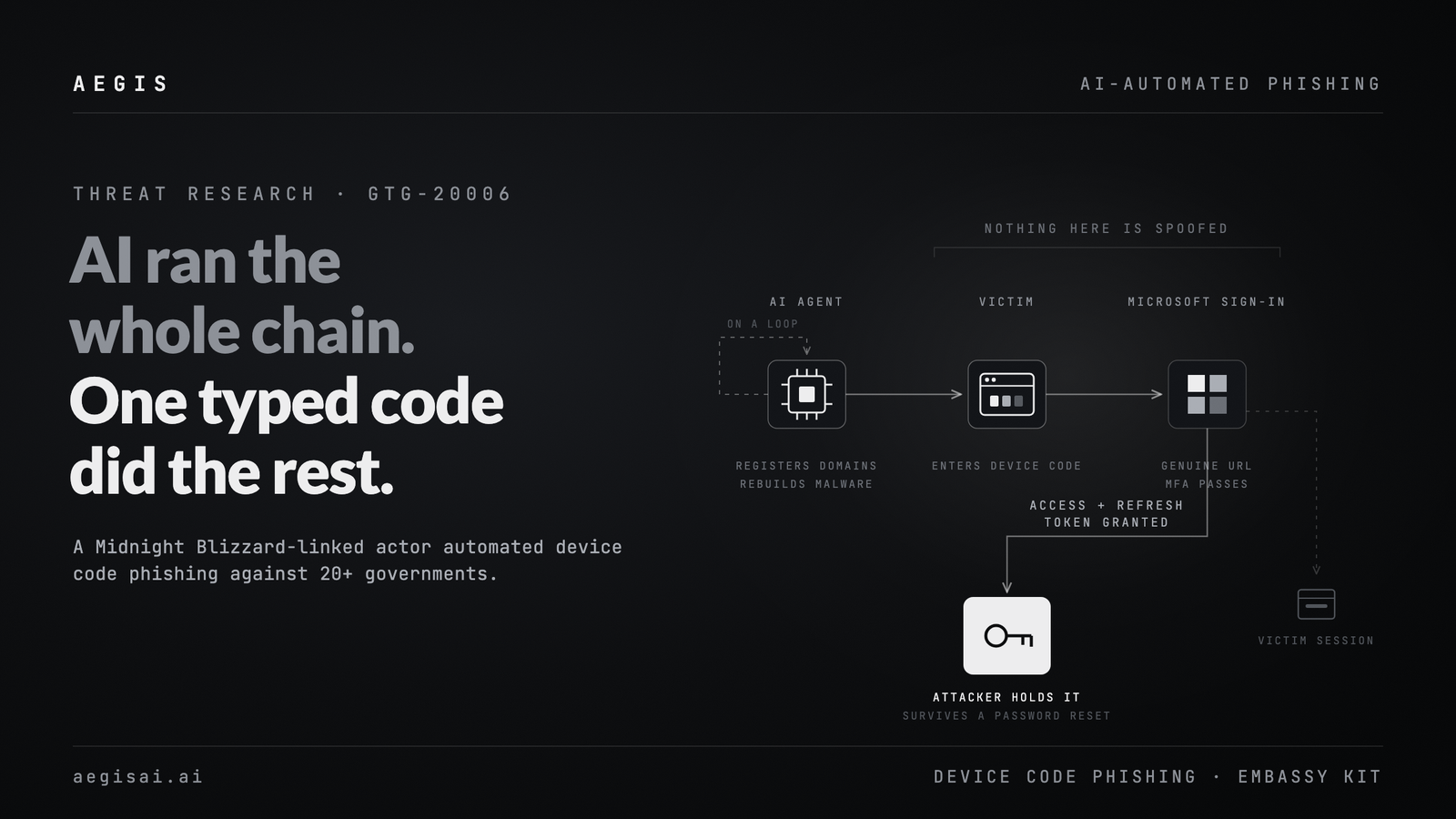
The clearest example is Adversary-in-the-Middle (AiTM) phishing. A reverse proxy sits between the user and the real login page, relays the credentials and the MFA prompt, and keeps the session token after MFA succeeds. The destination renders identically to the legitimate page, the link usually sits behind a redirect chain, and the mail itself often passes authentication. Static URL and domain checks miss it, because a rules engine was built to check strings against lists, and nothing about an AiTM lure is on a list yet.
Because the tells that filters and training relied on are gone. AI-written phishing has clean grammar, a role-appropriate tone, and a plausible pretext, and it can be generated per target at scale. In AegisAI's 2025 threat data, drawn from more than 20,000 phishing emails in production environments, 50.3% of AI-generated phishing bypassed the built-in Gmail and Microsoft filters, against 28.5% of human-written phishing. AI spear phishing evaded content filters 93.9% of the time and averaged 562 words, long enough to build a believable story rather than fire a keyword. And 72.6% of the AI spear phishing that got through passed DMARC.
None of those properties defeat a system that reads the request. A 562-word message asking finance to change a vendor's bank details is still a bank-detail change with nothing in the thread to support it, however well it is written. The attacker can change every surface feature of the message. They cannot change what they are asking for.
Agentic detection runs several layers of analysis on every message, in parallel, in the seconds after delivery, before the user sees or clicks it.
1. Signal extraction. The system pulls metadata (sending IP, reply-to address, authentication results, domain age), content (subject, body, HTML structure), and every attachment and URL. Images and PDFs are read for hidden text and embedded QR codes, which matters as quishing grows, since the malicious link never appears as clickable text.
2. Language and intent analysis. Language models read the email for what it asks the recipient to do. A request to verify an account, reset a password, or wire funds gets classified by intent, so a payment redirect phrased nothing like any known template is still recognized as a payment redirect. Urgency, secrecy, and pressure to skip verification are read as signals in their own right.
3. Identity and relationship analysis. The agents check whether the claimed identity, the sending infrastructure, and the authentication results agree, whether the domain is a near miss of a real one, and whether this sender and recipient have any prior correspondence. A first-ever wire request from an address that has never emailed finance is a signal even when every header checks out. Where relationship history exists it sharpens the verdict, but detection cannot depend on it: the first fraudulent invoice from a new vendor arrives with no history at all, and it still has to be caught.
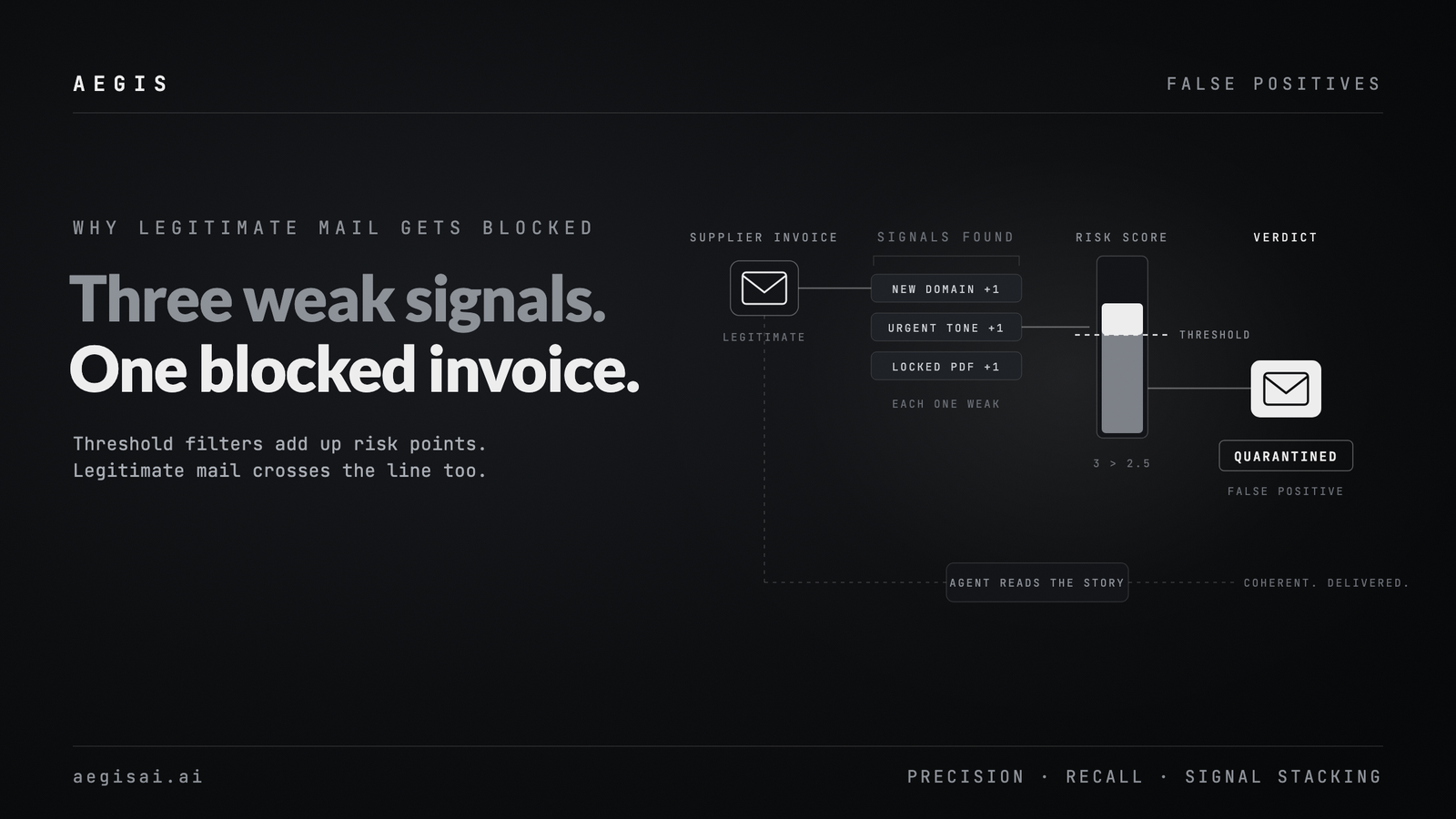
4. Reasoning and scoring. Rather than a binary allow or block, the agents weigh the signals together and produce a judgment with visible reasoning: which specific factors pushed the message over the line, whether that was an unfamiliar sender making a high-value ask, a mismatch between display name and sending domain, or a new payout account. Analysts need that to trust and verify decisions. Compliance teams need it to show that mail is not being blocked arbitrarily.
5. Action. Based on the judgment, the system removes the message, quarantines it, warns the user, or neutralizes a risky element such as a link or a macro, while letting legitimate mail through.
6. Adaptation from analyst feedback. Every correction, a released false positive or a confirmed miss, feeds back into the agents. Detection improves without anyone rewriting a rule.
The same reasoning applies across attack types. What changes is which signals carry the verdict.
Every attack in that table defeats a system that asks whether it has seen this exact indicator before. Every one is caught by a system that asks what the message is trying to make someone do, and whether the evidence around it holds up.
Vendors cite false-positive reductions and analyst-hours saved. Those numbers are only useful once you have tested them against your own mail flow. Before you buy, ask for:
If a vendor cannot produce numbers specific to your environment, treat their published statistics as a starting point for due diligence, and run a pilot on live mail before anything goes in front of your board. Our vendor evaluation framework covers the full question list.
Deployment architecture and data handling determine both your time to value and your risk exposure.
AegisAI is an AI-native, agentic email security platform. Its agents read every email the way an analyst would, weighing the request, the language, the identity claims, and the infrastructure together, and they do that from the first message, with no learning period. It deploys by API into Microsoft 365 or Google Workspace with no MX changes and is live in minutes. Customers see up to 90% fewer false positives than the tools it replaces while finding 22% more attacks, and SOC workload drops because investigation is automated rather than queued. Every verdict comes with the agents' reasoning in the dashboard, and VIP and role-based threat visibility shows which executives and finance roles are being targeted. The platform is SOC 2 Type II certified, encrypts data in transit and at rest, and does not retain full email content beyond what analysis requires. The founding team previously built reCAPTCHA, Safe Browsing, and Web Risk at Google.
Can AI detect phishing emails that have no link or attachment? Yes, and this is where it separates from filters. A message with no payload gives a signature engine nothing to match, but the request inside it can still be judged: who is asking, what for, whether the sending infrastructure supports the claimed identity, and whether anything in the thread supports the ask. That is how BEC and CEO fraud get caught.
Does AI email security need a learning period before it works? AI-native systems do not. They reason about each message on its own evidence, so a new employee, a new vendor, or a first-time request is judged the same way on day one. Products that depend on a behavioral baseline typically need weeks of mail history before detection is reliable, and remain weakest on exactly the first-contact messages BEC uses.
Does AI email security replace a secure email gateway? It can. Because it deploys by API it can also run alongside an existing gateway during evaluation, so most teams compare the two on live mail before deciding. The gateway's remaining value is usually limited to spam volume and policy enforcement, both of which API-based platforms also cover.
What is the difference between AI-powered and AI-native email security? AI-powered is a marketing term that covers both. AI-native means the reasoning is the detection engine and each message gets a verdict on its own merits. AI-assisted means a rules-based core with machine learning scoring added on top, where a message that matches nothing known still passes.
Before your next renewal, run this checklist against your current filter and any vendor you are evaluating.
The fastest way to see how agentic reasoning handles the phishing and BEC attempts already reaching your users is to look at your own mail. Book a demo for a live walkthrough, or start with AegisAI's free 14-day BEC assessment, which connects read-only by API and reports what your current filter passed, with the reasoning behind each verdict.