Last updated: September 8, 2026
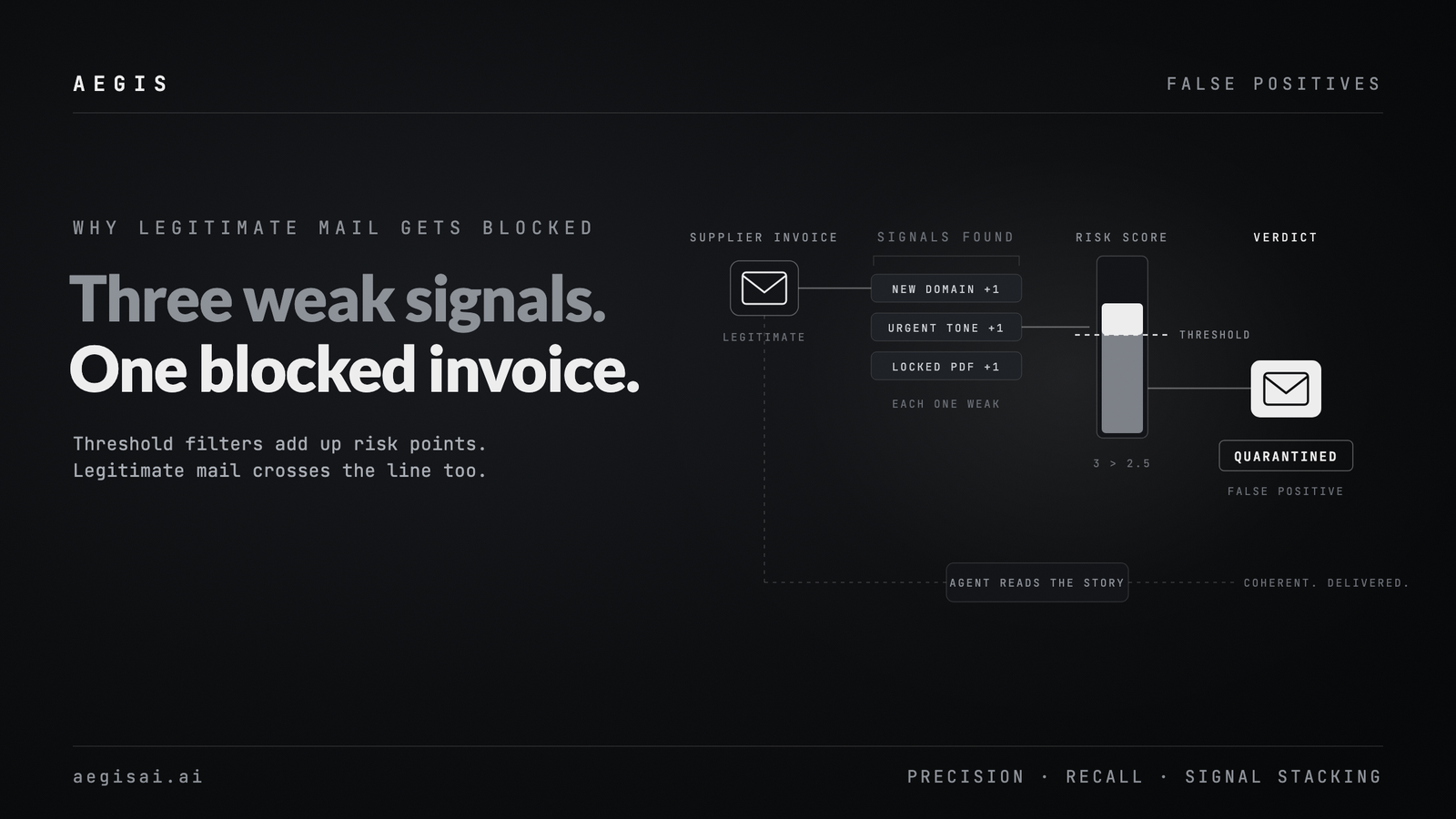
A false positive happens when a filter stacks enough individually weak signals, an unfamiliar domain, an urgent subject line, a password-protected PDF, to cross a quarantine threshold, even though no single signal proves the message is malicious. The fix most vendors offer is a better process for releasing mail after the fact: reporting buttons, triage queues, narrower allowlists. That reduces pain. It does not reduce the rate at which legitimate mail gets misclassified, because the detection model itself, add up the risk points and compare to a threshold, is what generates the errors.
Most guides stop at the mechanics: how signals stack, what SPF, DKIM, DMARC and ARC prove, how to measure precision and recall, how to investigate a blocked message. This one covers those and then explains why threshold-based detection structurally trades false positives against false negatives, and what changes when detection reasons about the whole message instead of scoring it.
What is an email security false positive?
A false positive is a legitimate email that a filter classifies as spam, phishing, malware, or impersonation. It says nothing about whether authentication passed or failed, only that the final verdict was wrong. A false negative is the opposite error: a malicious message the filter let through.
| Filter verdict | Message is legitimate | Message is malicious |
|---|
| Delivered | Correct (true negative) | False negative: missed attack |
| Blocked or quarantined | False positive: blocked mail | Correct (true positive) |
Both errors carry real cost, and they are not symmetric. A false positive delays a payment or a customer reply. A false negative can end in a fraudulent wire transfer or stolen credentials. Any plan to "reduce false positives" that ignores false-negative risk solves half the problem, and in legacy systems, solving one half usually makes the other worse.
Why do traditional email filters generate so many false positives?
Secure email gateways (SEGs) score signals (sender reputation, domain age, authentication results, keyword matches, attachment type, URL reputation) and compare the total to a policy threshold. Each signal is weak evidence on its own. A new vendor domain is slightly risky. Urgent payment language is slightly risky. A password-protected attachment is slightly risky. None of them prove malice, but a legitimate invoice from a new supplier can collect three or four weak signals and cross the same threshold a real attack would.
This is a structural tradeoff built into the model. Tighten the threshold to catch more phishing and you flag more legitimate mail. Loosen it to stop interrupting the business and you let more attacks through. Every rule an administrator adds to close one gap opens an edge case somewhere else, and mail-flow rules rarely get retired, so teams end up with years of accumulated exceptions that nobody remembers the reason for. That is why false-positive complaints and missed-attack complaints rise and fall together in SEG environments. The filter is doing what it was designed to do, and the design is the problem.
Signal stacking also needs signals to stack. No-payload phishing, a plain-text message asking someone to move money or share credentials with no link and no attachment, gives a content scanner and a URL inspector nothing to inspect. Adversary-in-the-middle (AiTM) attacks that proxy a real login page pass authentication checks cleanly. Signal-stacking models do not fail these cases with false positives. They fail with false negatives, because the model was built to inspect artifacts that attackers stopped including.
Which legitimate emails get flagged most often?
The messages that trigger the most false positives share surface features with attacks: financial urgency, unfamiliar senders, unusual formatting, or automation at scale.
- Invoices and payment changes. New bank details, urgent language, external links. Necessary for accounts payable, and indistinguishable from BEC by keyword alone.
- New vendor first contact. A domain with no reputation history, carrying a contract or onboarding form.
- Payroll and HR notices. Secure portal links, tax documents, benefit deadlines.
- Rebranded or migrated senders. A company that changed domains after a merger or provider switch loses reputation history it has not yet rebuilt.
- Forwarded messages. Original authentication and context degrade as a message passes through relays or mailing lists.
- Bulk and automated mail. Newsletters, ticketing alerts, and password-reset notices share formatting patterns with mass phishing campaigns.
Risk should scale with four things: how new or unfamiliar the sender is, which department the message lands in (finance, payroll, and executive inboxes carry more consequence than marketing), what the message asks the recipient to do, and how reversible that action is. A marketing email can wait for review. A wire-transfer request cannot wait, and it also cannot be approved on the strength of a friendly tone.
What does a false positive cost the business?
The direct cost is the blocked message. The larger cost is everything it triggers: an employee searching quarantine, a repeated report, a call to IT, a resend through an uncontrolled channel, a supplier who assumes they were ignored. None of that shows up in a filter's accuracy dashboard.
On the security team's side, every quarantined message that gets reported has to be classified, traced to the control that flagged it, and either released or escalated. That work scales with headcount unless it is automated. Repeated low-value alerts also produce warning fatigue: employees stop reading warnings, stop reporting promptly, or push IT to allowlist a sender permanently to make the friction stop. A permanent allowlist is a standing exception an attacker can walk through later if that sender's account is ever compromised.
| Cost | False positive | Missed malicious email (false negative) |
|---|
| Immediate effect | Delayed work, repeated contacts | Credential theft, fraudulent payment, malware execution |
| Who is affected | Employee, manager, IT or SOC | Target employee, security, finance, legal, leadership |
| Time to resolve | Minutes to days | Days to months, including containment and recovery |
| Right response | Faster, evidence-based release | Better detection at the point of delivery |
Neither error is solved by weakening the defense against the other.
What do SPF, DKIM, DMARC, and ARC prove?
SPF (Sender Policy Framework) checks whether the connecting mail server is authorized to send for the domain. DKIM (DomainKeys Identified Mail) verifies a cryptographic signature confirming the message was not altered after signing. DMARC ties those results to the visible From address and tells receivers what to do when they do not align. ARC (Authenticated Received Chain) preserves earlier authentication results as a message passes through forwarders or mailing lists, so a broken chain downstream does not automatically read as fraud.
These protocols answer one question: was this domain authorized to send this message? They do not answer whether the request inside the message is legitimate. A compromised vendor account, a lookalike domain with correctly configured DNS, or an AiTM proxy can all pass SPF, DKIM, and DMARC. In our own 2025 threat data, 72.6% of the AI-written spear phishing that got past native filters passed DMARC. Authentication is necessary infrastructure. Misconfigured records and broken alignment cause a meaningful share of false positives on their own, and fixing DNS is almost always the right first move before touching a policy threshold. But authentication was never designed to detect intent, and treating a DMARC pass as a green light creates a blind spot attackers already use.
How should you measure whether your filter is working?
Two numbers matter more than an overall accuracy claim: precision and recall.
Precision = true positives divided by (true positives + false positives). If a filter quarantines 1,000 messages and 100 are malicious, precision is 10%. That is severe overblocking, regardless of how many real attacks it also caught.
Recall = true positives divided by (true positives + false negatives). A filter that catches 90 of 100 real attacks has 90% recall. The 10 it missed are your remaining exposure.
False-positive rate (FPR) = false positives divided by (false positives + true negatives): the share of legitimate mail incorrectly blocked, measured against a labeled sample, not against total mail volume.
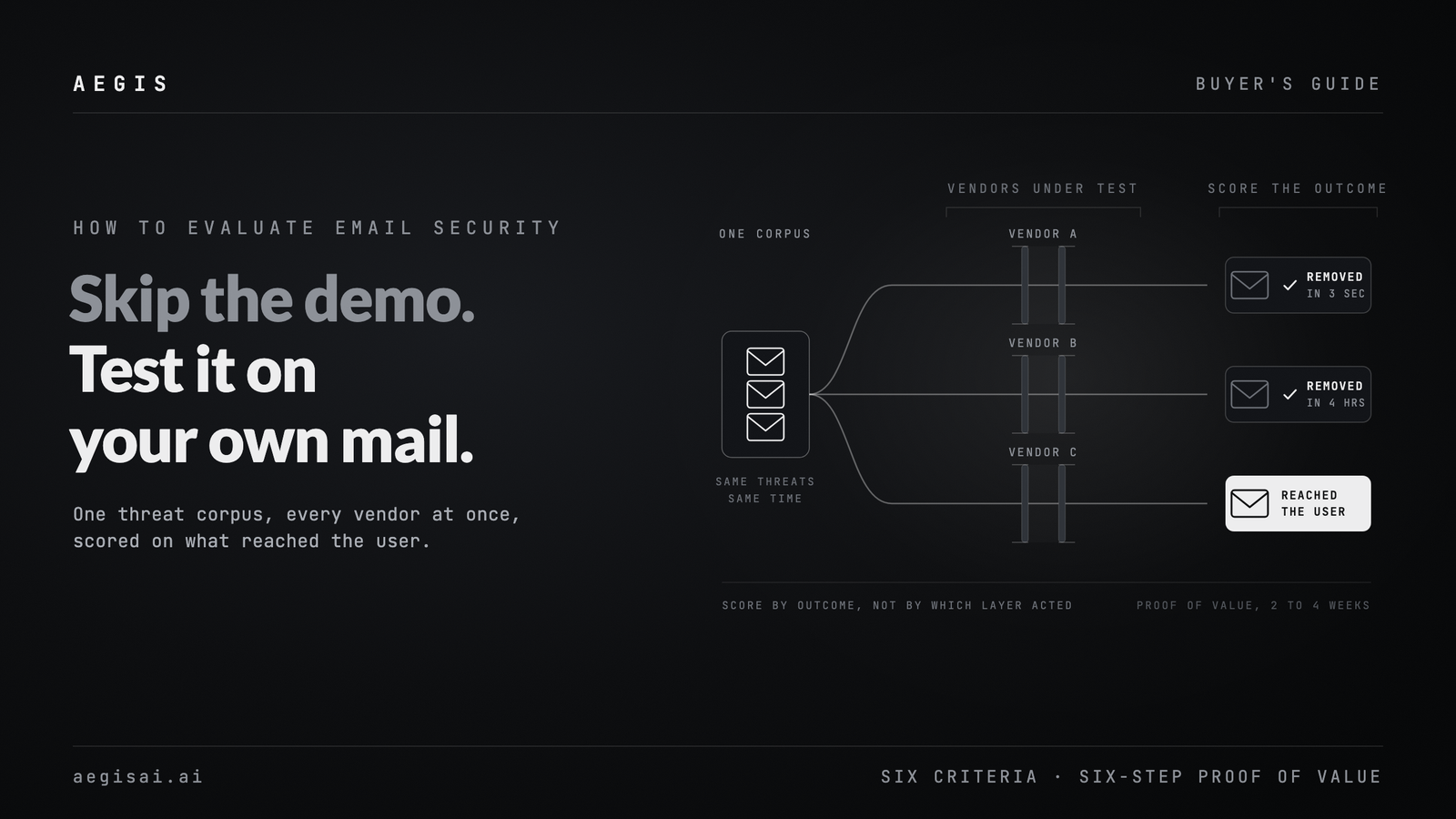
Report these together, by department and message type, not as one organization-wide average. A low overall false-positive rate can hide a finance team that loses an invoice every week. Track release rate (how often quarantined mail is later confirmed safe), repeat-flag rate (the same sender blocked again after release), and time to resolution. Those three tell you whether the problem is a bad rule, a reputation gap, or an authentication misconfiguration. If you are comparing vendors, our guide to evaluating email security vendors covers how to verify a false-positive claim on your own mail instead of taking the number from a slide.
How do you cut false positives without opening the door to phishing and BEC?
The conventional playbook (narrower allowlists, tiered policy actions, better employee reporting) reduces friction without touching the tradeoff. It is a threshold model wrapped in a better appeals process. Cutting false positives without adding risk requires changing what the detection step does with a message.
Mechanically, instead of scoring independent signals and comparing them to a fixed threshold, an AI agent reasons about the message as a whole, the sender, the language, the requested action, and the relationship between them, the way an analyst would read the same email before deciding whether to escalate it. A new vendor's first invoice is not automatically risky. It is risky if the language, the payment request, and the domain history do not cohere into a plausible business story. A threshold cannot make that call, because a threshold has no concept of a story, only points.
This matters most where signal stacking fails hardest: no-payload phishing and AiTM. There is no attachment to scan and no bad link to flag, so a signal-stacked model either ignores the message or flags every plain-text urgent request, including the real ones from real executives. Reasoning over language and context, whether the request fits who is asking and what the thread has been about, and whether the urgency matches a real business event, catches the attack without penalizing every legitimate urgent message that looks similar on paper.
What should you do when a legitimate email gets blocked?
- Do not click, open, or reply from the blocked copy. Treat it as unverified until confirmed.
- Use the report and release workflow, not a personal allowlist request. Note the expected sender and the business context.
- Have an admin check headers and authentication (SPF, DKIM, DMARC) before releasing. A pass does not guarantee safety, and a fail does not guarantee malice.
- Verify high-impact requests out of band. Payment or bank-detail changes get a call to a known number, not a reply to the email.
- Release narrowly, to the one recipient, with a documented reason, not as a domain-wide exception.
- Fix the root cause. Correct a DNS record, tighten a mail-flow rule, or log a detection gap for review, rather than adding a permanent bypass.
How AegisAI approaches false positives
AegisAI's AI email security for phishing evaluates each email the way an analyst would, reasoning across the sender relationship, the language, the request, and its context in real time, rather than scoring isolated indicators against a fixed threshold. That mechanism is why customers see up to 90% fewer false positives than legacy filters while catching 22% more attacks. The agent judges whether the message coheres as a business story instead of adding up risk points.
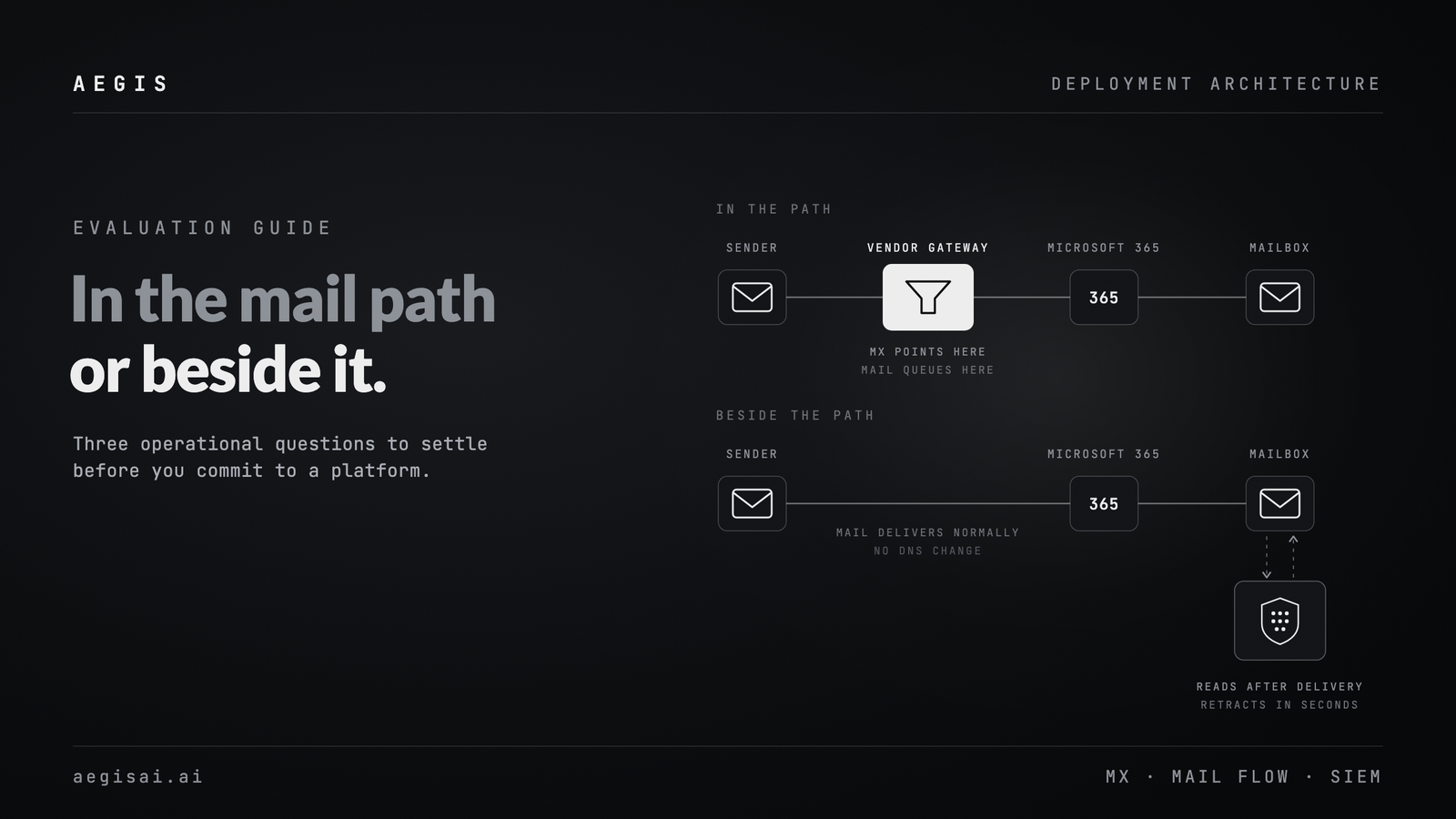
The platform deploys by API into Microsoft 365 and Google Workspace with no MX record changes and no mail-flow disruption, and goes live in minutes. Every verdict is explainable in the dashboard, no black-box score, so your team can see why a message was flagged and correct course quickly. Role-based and VIP visibility gives finance, executive, and other high-value inboxes the tighter scrutiny they warrant without extending that friction to every mailbox. AegisAI is SOC 2 Type II certified, encrypts data in transit and at rest, and does not retain full email content beyond what analysis requires.
Frequently asked questions
What is an acceptable false-positive rate for enterprise email security? There is no universal number. Set it by business impact per message category. A rate that is fine for marketing mail may be unacceptable for payroll or executive communication. Measure on a labeled sample and segment by department.
How is the email security false-positive rate calculated? FPR = false positives divided by (false positives + true negatives), measured against a sample where every message has an independently confirmed label, not against total filtered volume.
Should a legitimate email marked as malicious be allowlisted? Release it narrowly to the intended recipient with a documented reason. Avoid domain-wide or sender-wide allowlists. A trusted domain can be compromised later, and a standing exception becomes a standing hole.
Does reducing false positives increase phishing risk? Only if you reduce them by loosening a threshold. Reducing them by improving how the message is judged, context and intent instead of signal count, lowers false positives and false negatives at the same time.
Next steps
Pull a 30-day sample of quarantined mail, label it against confirmed outcomes, and calculate precision, recall, and false-positive rate by department before you touch a single policy threshold. If finance and executive inboxes carry a disproportionate share of the friction, the problem is the detection model, and more user training will not fix it.
To see how agentic reasoning handles the invoices and vendor emails your current filter keeps flagging, book a demo.