Technical Guides
How to Prevent Business Email Compromise: BEC Protection That Works
How BEC attacks work, why they pass SEGs and DMARC, spoofed vs compromised senders, what detection must analyze, and the controls that stop invoice fraud.



Last updated: September 11, 2026
Business email compromise works because it looks like ordinary business mail. There is no malware, no malicious link, and usually nothing in the message a scanner can object to. The only thing wrong with it is the request. Stopping it takes security that evaluates intent, relationships, and the claim a message is making, the way an analyst would, rather than a filter that checks for known-bad indicators. This guide covers how BEC attacks work, why they pass secure email gateways and DMARC, what detection has to analyze to catch them, and the layered controls that hold up against AI-written, context-aware attacks.
Business email compromise (BEC) is email fraud in which an attacker impersonates, or takes over, a trusted identity to get someone to take a high-value action: wire money, change payment details, send sensitive data, or grant access. BEC is defined by its goal, not its delivery mechanism. It rarely carries a payload, which is exactly why it gets past tools built to inspect attachments and URLs.
The FBI's Internet Crime Complaint Center put BEC losses at $2.77 billion in 2024, more than any category except investment fraud. The dollar figure matters less than the mechanism behind it. A BEC email does not fail a scan, because there is nothing in it to scan. It fails a judgment call, so judgment is what has to catch it.
The technical setup varies, but most BEC follows the same five-step arc.
What makes this hard to catch is patience, not technical sophistication. An attacker who compromises a supplier's mailbox can sit inside it for weeks, reading real threads, before inserting a single fraudulent message that inherits all the trust of the conversation around it.
Secure email gateways (SEGs) were built to catch things: known-bad domains, malicious attachments, flagged URLs. A well-crafted BEC email has none of them. It comes from a domain with a clean reputation, carries no attachment, and reads like something a colleague would write, because increasingly a language model wrote it.
Four properties make BEC structurally resistant to rule-based detection.
| Property | Why it defeats static rules |
|---|---|
| No payload | Nothing to sandbox, detonate, or match against a signature. |
| Trusted infrastructure | Sent from a compromised real account, or from a domain with no reputation history at all. |
| Contextual language | AI-written text matches the tone, role, and urgency of real business mail without tripping keyword filters. |
| Multi-stage delivery | The early messages are harmless. The fraudulent ask arrives later, inside an established thread. |
Generative AI made this measurably worse. It collapses the time and skill needed to write a convincing, role-specific, grammatically clean message in the target's own language. In AegisAI's State of the AI Threat in Email: 2025 report, drawn from more than 20,000 phishing emails in production environments, 50.3% of AI-generated phishing bypassed the built-in Gmail and Microsoft filters, against 28.5% of human-written phishing, and AI spear phishing evaded content filters 93.9% of the time. A rule tuned to catch clumsy phishing from three years ago has nothing to catch here.
This distinction changes your whole response, and most tooling glosses over it. A spoofed sender means the attacker never touched the real mailbox. They forged the From address or registered a lookalike domain. Authentication failures (SPF, DKIM, DMARC) usually surface this, and a DMARC reject policy on your own domain stops the crudest version. A compromised sender means the attacker is operating inside the real account, sending from real infrastructure with valid authentication.
Compromise is harder to catch and more dangerous, because it inherits the sender's entire reputation, history, and thread context. In the same report, 72.6% of the AI spear phishing that got through passed DMARC. Authentication answers who sent a message. It was never built to judge whether the request inside it is real. Detecting compromise means looking at the account and the request together: a sign-in from a new country, a mailbox rule quietly created to forward or delete replies, a request the thread does not support. If your BEC protection cannot tell you which of the two situations you are in, your response (reset credentials versus block a domain) will target the wrong problem.
A growing share of BEC never targets your mailboxes at all. It targets a supplier's. The attacker compromises a vendor's real mailbox, waits inside real threads with your finance team, and then inserts one message changing the payment instructions on an invoice that was already legitimate. The thread, the names, the amounts, and the history are all real, so this pattern beats almost every reputation-based or rule-based control.
Catching it means evaluating the change itself: is this the first time bank details have moved in this relationship, does the request match the invoice already in the thread, and would the real vendor make this change by email with no call? Sender history helps when it exists, but detection cannot depend on it. The first fraudulent invoice from a new vendor arrives with no history at all, and it still has to be caught.
Effective BEC detection combines several independent signal types, because any single signal can be spoofed or absent. Here is what each one contributes.
| Signal | What it tells you | Example |
|---|---|---|
| Intent and language | The ask embedded in the message (payment redirect, credential request, urgency framing), independent of keywords. | A bank-detail change phrased nothing like any known template. |
| Relationship and thread context | Whether this sender and recipient have corresponded before, and whether the thread supports the request. | A first-ever urgent wire request from a domain that has never emailed finance. |
| Authentication results (SPF, DKIM, DMARC) | Whether the sending domain is spoofed, as opposed to the mailbox itself being taken over. | A DMARC failure points to spoofing. A clean pass with a suspicious request points to compromise. |
| Account and infrastructure signals | Evidence that the account itself has been taken over. | A new inbox rule that forwards and deletes replies, or a sign-in from a new region. |
| Lookalike and identity analysis | Whether a domain or display name is a near miss of a real one. | acme-corp.co standing in for acme-corp.com, or a display name matching the CFO on a free webmail address. |
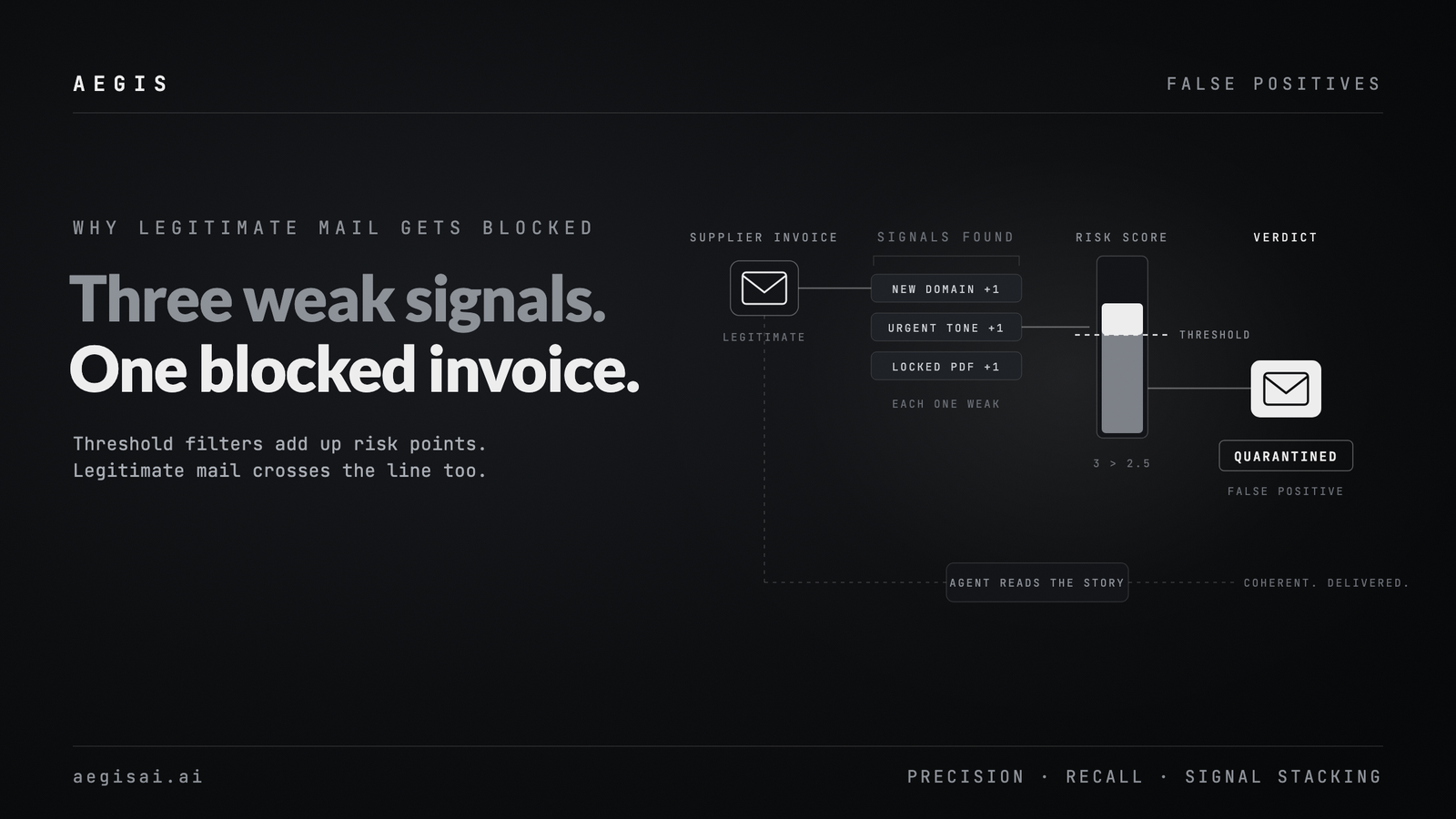
No single row is sufficient on its own. A domain can pass every authentication check and still be sending fraud if the mailbox was compromised. Language analysis can flag urgency and still miss a request phrased as routine. The value is in reasoning across all of them together, the way an analyst triages an escalation, rather than running each as an isolated pass-or-fail rule and adding up the points.
No single control stops BEC. Layer these four categories.
Identity
Anti-spoofing
Process
People
Detection sits across all four layers. Compare tools on how they handle a message with no payload, valid authentication, and a plausible request, because that is the message your current filter delivers. Our vendor evaluation framework covers the questions to ask.
They overlap, but they are not the same thing. Phishing is a delivery mechanism: a broad set of tactics for stealing credentials or delivering malware, often at volume. BEC is a fraud outcome: targeted, workflow-aware, and usually free of any malicious link or attachment. Phishing is often a step inside a BEC campaign, used to get into the mailbox in the first place, but a large share of BEC succeeds through social engineering alone, with nothing for a scanner to flag. That is why a tool that is good at phishing can still be poor at BEC.
AegisAI's BEC prevention agents read every message the way an analyst would: what is being asked, who is asking, whether the thread and the relationship support the request, and what the authentication results prove about the sending infrastructure. Authentication is one input, never the verdict. Because the agents judge the request on its own terms, a vendor's first fraudulent invoice is caught even when there is no history to compare it against, and a legitimate executive travelling or a supplier changing tone does not trigger the constant false alarms that rigid impersonation rules produce.
That reasoning is why customers see up to 90% fewer false positives than the tools AegisAI replaces, while finding 22% more attacks in production. Deployment is by API into Microsoft 365 or Google Workspace with no MX changes, runs alongside your current filter, and is live in minutes. Detection and remediation happen in seconds, before users see or click. Every verdict comes with the agents' reasoning rather than a score, and VIP and role-based visibility shows which executives and finance roles are being targeted.
Does DMARC stop business email compromise? Only the crudest form. A DMARC reject policy stops attackers from sending mail that claims to be from your exact domain. It does nothing against lookalike domains, display-name spoofing, or a real account that has been taken over, and most successful BEC uses one of those three. Authentication verifies infrastructure, not intent.
Can AI-generated emails increase BEC risk? Yes. Generative AI removes the grammar and tone tells that training used to rely on, and it lets attackers write long, personalized pretexts at scale. In AegisAI's 2025 threat data, AI spear phishing averaged 562 words and evaded content filters 93.9% of the time.
Is CEO fraud the same as BEC? CEO fraud is one type of BEC. It is executive impersonation: an attacker posing as a senior leader to push an urgent wire, gift card purchase, or data request past a subordinate. Invoice fraud, payroll redirect, and vendor email compromise are other BEC types that impersonate someone other than an executive.
How fast do you need to act after a fraudulent wire? Immediately. Banks can sometimes recall or freeze funds if notified within hours, and in the US the FBI's IC3 Recovery Asset Team can help freeze domestic transfers when a complaint is filed quickly. After a few days, the money has usually moved through mule accounts and is gone.
BEC protection is not a single feature. It is identity controls, verification process, and detection that judges the request instead of scanning for a payload. Start by testing whether your current tools can tell a spoofed sender from a compromised one. If they cannot, that is the gap to close first.
The fastest way to know what is getting through today is to look. AegisAI's free BEC assessment connects read-only by API, re-reads the last 14 days of delivered mail, and reports every BEC and invoice-fraud attempt your current filter passed, with the reasoning behind each verdict. Or book a demo to watch the agents work through a live BEC attempt.