Every security team has an inventory it trusts and a reality it can't see. You approved a handful of tools. Your people are using far more, signed up in a browser tab, paid for on a personal card, connected with one OAuth click. The fastest-growing slice of that is shadow AI: the GenAI tools employees paste source code, customer records, and contracts into, with no review and no log.
The hard part was never knowing shadow IT exists. It is finding it without a heavy rollout, and then knowing which apps actually matter.
The Problem: Discovery Tools Look From the Outside
The usual ways to find unsanctioned apps all look at your organization from the outside, and each misses a different part of the picture.
- CASBs and proxies see traffic on the network. They go blind the moment someone works off-network or on a personal device.
- SSO and identity logs only see apps that went through single sign-on. The self-serve signups that define shadow IT never touch SSO, so they never appear.
- Endpoint agents depend on being installed everywhere, which they rarely are.
So you get a partial list of domains with no sense of priority. The unsanctioned GenAI tool a finance lead is feeding data into looks the same as the scheduling app the whole company uses.
A New Approach: Reasoning, Not Catalogs
We don't crawl your network or scrape a catalog. We reason.
Every app announces itself in the inbox: a welcome email, a receipt, a "document shared with you." Our agents already read that mail to stop phishing and malware, so they already hold the ground truth of every app every employee touched. Pointing that same reasoning at SaaS and AI takes nothing new to deploy.
And because the agents already understand your organization, discovery comes with context a scanner can't reconstruct.
| Feature |
Discovery tools (CASB / SSPM) |
AegisAI |
| Vantage point |
Outside-in scan, no organizational context. |
Agents that already understand your organization. |
| Coverage |
On-network or SSO-integrated apps. |
Any app that sends an email, including non-SSO signups. |
| Output |
A list of domains. |
Apps ranked by in-context and intent data risk. |
| New tooling |
Proxy, agent, or connector. |
2 minutes API deployment. |
What You Get
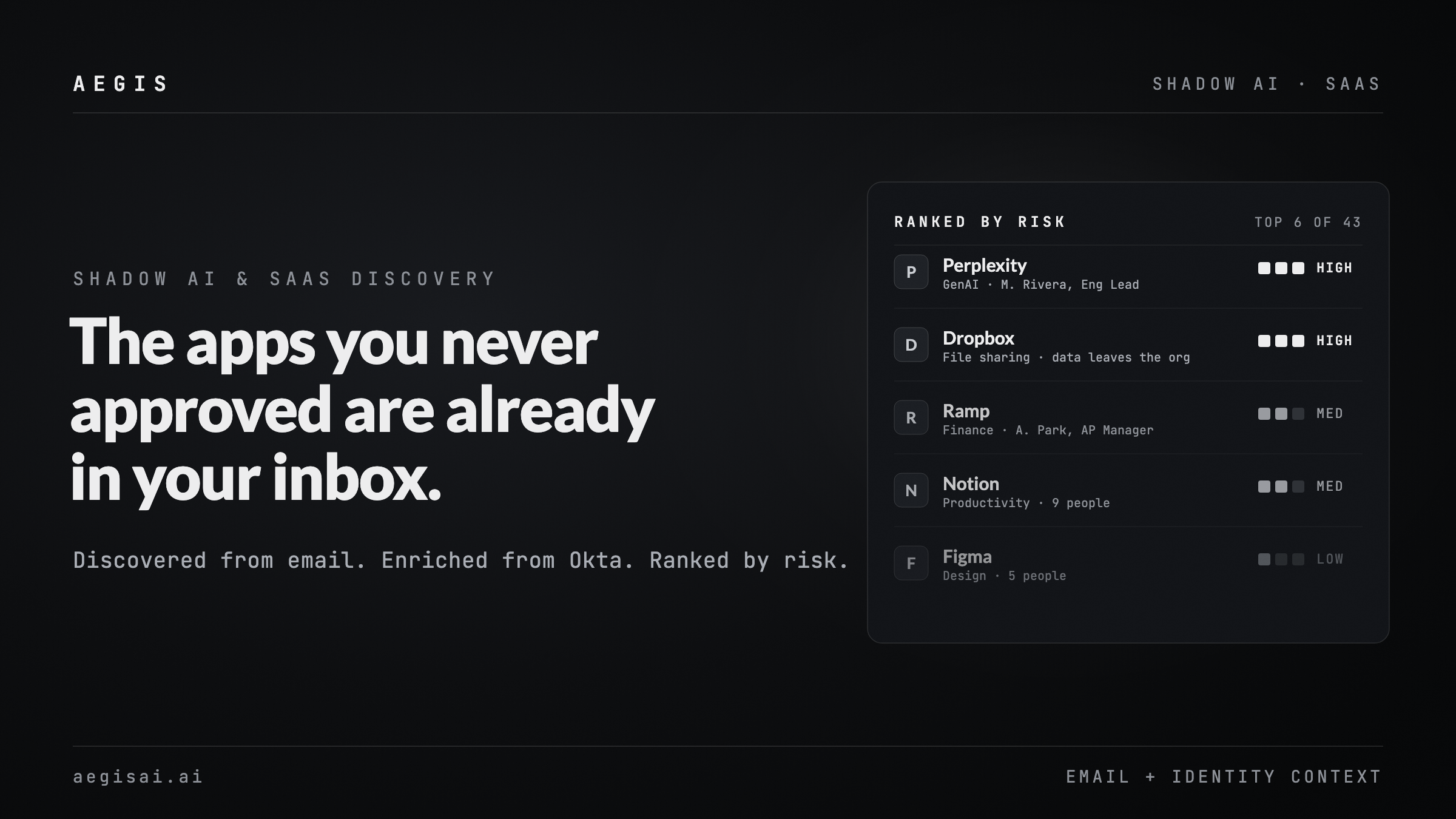
Every app, including the ones SSO can't see. Email captures the signup whether or not the app ever touched your identity provider, so the self-serve and shadow AI tools that bypass SSO still show up.
The people behind each app. Discovery is enriched with the person, role, and department from your identity provider, such as Okta or Entra. You see not just which apps are in use, but who is using them and in what role. A GenAI tool in the hands of an engineering lead is a different risk than the same tool used once by an intern.
A list ranked by real risk. Apps are scored by data sensitivity and exposure, not a flat category label. An unsanctioned file-sharing or GenAI tool, where data leaves the org, surfaces above a known, access-controlled finance app. The riskiest apps come first, each with the detection email behind it as evidence.
Why AegisAI?
AegisAI comes from the team that built Gmail's defenses and scaled Google Safe Browsing. The same agents that read every message to stop attacks now map the apps that message traffic reveals.
That is the compounding part. Protecting your email builds context about your organization. That context surfaces shadow AI and SaaS that outside scanners miss. A fuller picture of your app footprint then sharpens the threat detection. Each layer makes the next one better, which is the advantage of one platform that reasons over your environment instead of separate tools that scan it.
The apps you never approved are already in your inbox. Now you can see them, ranked by the data they expose, with nothing new to deploy.