Announcements
A Spam Filter for the AI Era
Your most important email shouldn't be in junk. We are taking the exact same agentic reasoning that stops advanced phishing and malware, and applying it to the rest of your mail.

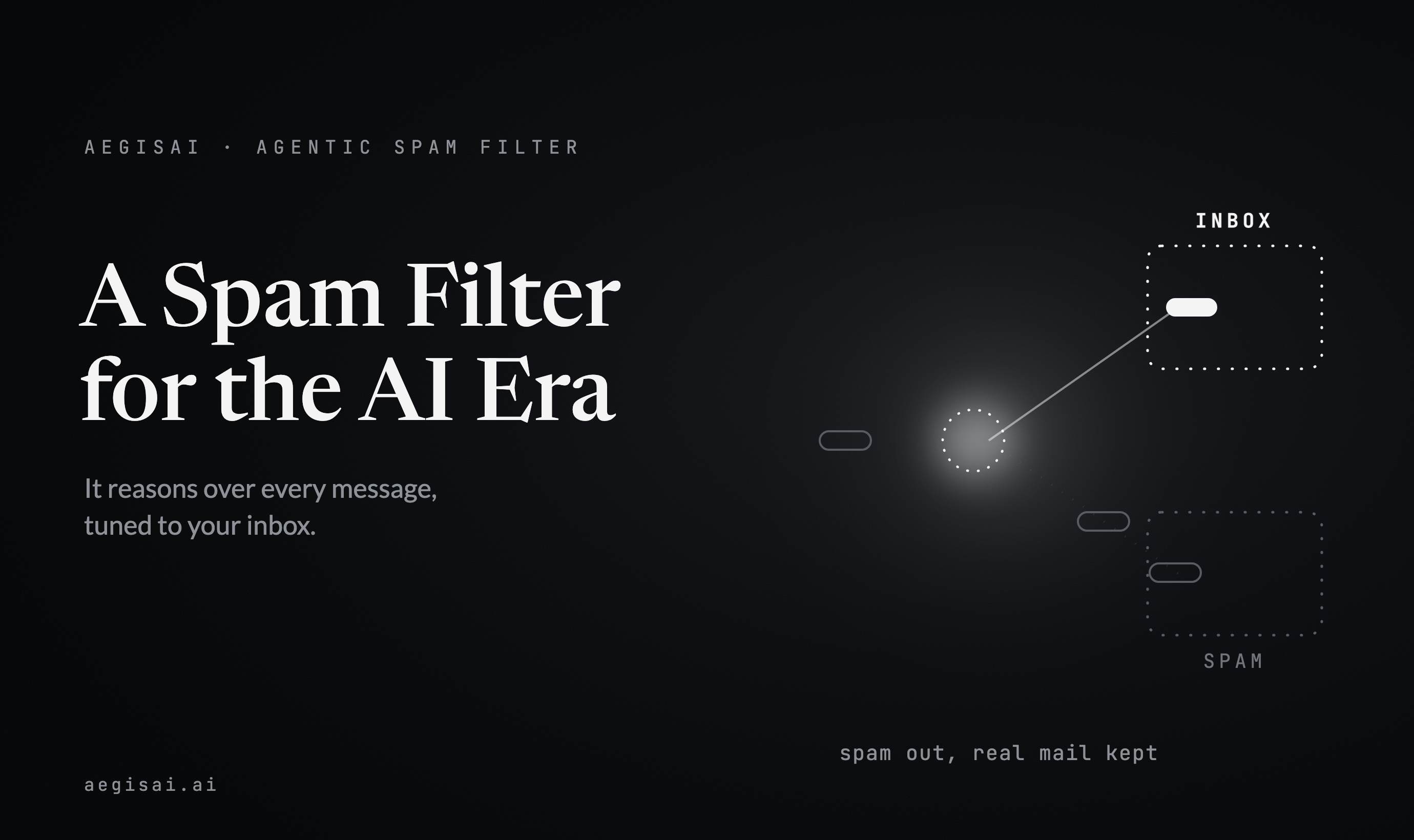

Your most important email shouldn't be in junk. We are taking the exact same agentic reasoning that stops advanced phishing and malware, and applying it to the rest of your mail.
Why does spam still plague every inbox? It is an age-old problem we have fought for more than a decade, first as part of Gmail's defenses, Google Search and now at AegisAI. The tools kept changing, but one limitation never did: a filter had to guess what mattered to each person. That is finally changing. LLMs and AI agents can now understand what a message actually says, and deliver protection personalized to each individual's preferences.
Everyone worries about the spam that slips through. It's annoying, but you delete it and move on. The truly expensive failure is the reverse: the critical message that never reaches you. A signed contract, a candidate who finally replied, or a customer escalation sitting in a spam folder no one opens.
Traditional filters were never built to catch that kind of failure. So, we built an agentic spam filter that does.
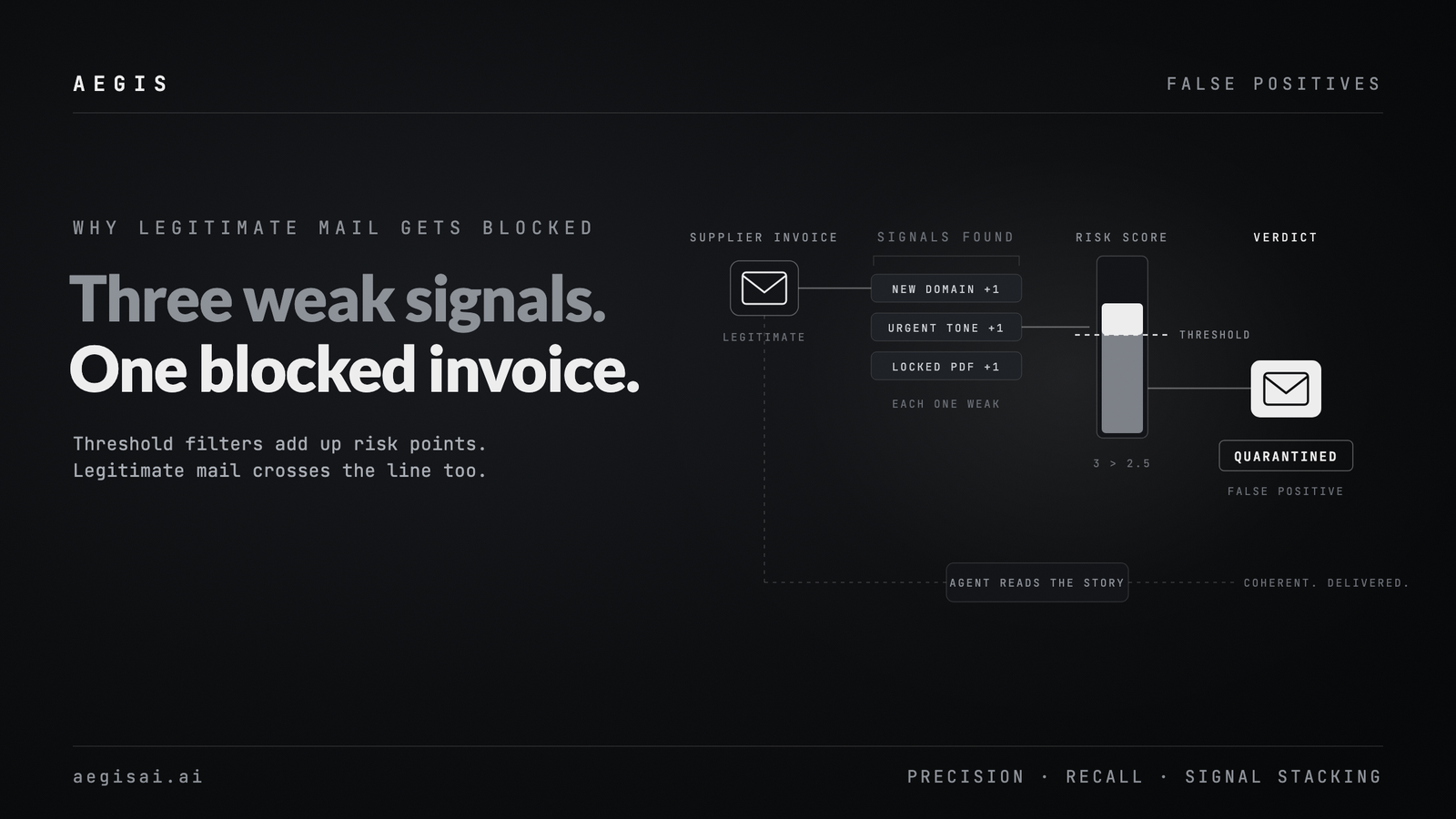
Legacy filters classify emails based on surface signals: sender reputation, bulk-send patterns, keywords, and authentication. In today's landscape, that leaves every inbox with a hard trade-off. Tighten the dial and you bury real mail. Loosen it and the noise floods back.
The numbers show just how often these legacy rules fail:
A filter reading only surface signals can't reliably tell wanted from unwanted, so it guesses.
We don't classify. We reason.
Our new agentic spam filter looks at each message the exact same way your own analysts would. We leverage the identical reasoning engine that already protects your environment from sophisticated attacks hiding behind clean reputations.
Without anyone setting a rule, our agents pick up on what each person treats as a signal: the senders they reply to, the messages they rescue from spam, and the ones they banish there themselves. People are different, and their inboxes should be too.
Because the agents already read every message to stop malware and phishing attacks, this works instantly with the access you've already granted.
1. A Drastic Drop in False Positives
Your most important mail reaches the inbox where your team can actually act on it. By reasoning through context rather than tripping over keywords, the same agents that cut false positives on security threats by up to 90% now bring that exact same accuracy to the rest of your mail. Your IT team fields fewer "where's my email?" tickets, and your people stop digging through quarantine for emails they were expecting.
2. A Hyper-Focused Inbox
As AI-generated spam floods the system, your inbox automatically adapts to filter out the noise. Over time, each inbox learns to perfectly fit the person who uses it, prioritizing signal over spam and keeping your team focused on the work that actually matters.
AegisAI comes from the team that built Gmail's defenses and scaled Google Web Risk, protecting email at a massive scale. It's why forward-thinking teams like Notion and LangChain trust us with the inboxes that run their businesses.
For decades, filters have tried to solve spam by classifying it. The real missing piece was judgment. We built agents that can make that judgment to stop attacks. Now, they make it on the mail that reaches your team.