Resource: The "Copy/Paste" Warning for IT Admins
Need to warn your team fast? Copy the text below into Slack or email to get the word out immediately.
Subject: ⚠️ ALERT: 5 Black Friday Scams (Powered by AI)
Message:Team, retailers started Black Friday deals early this year, and so have the scammers. Please be extra vigilant, especially when using work devices for personal shopping.
Watch out for these top 5 triggers we are seeing right now:
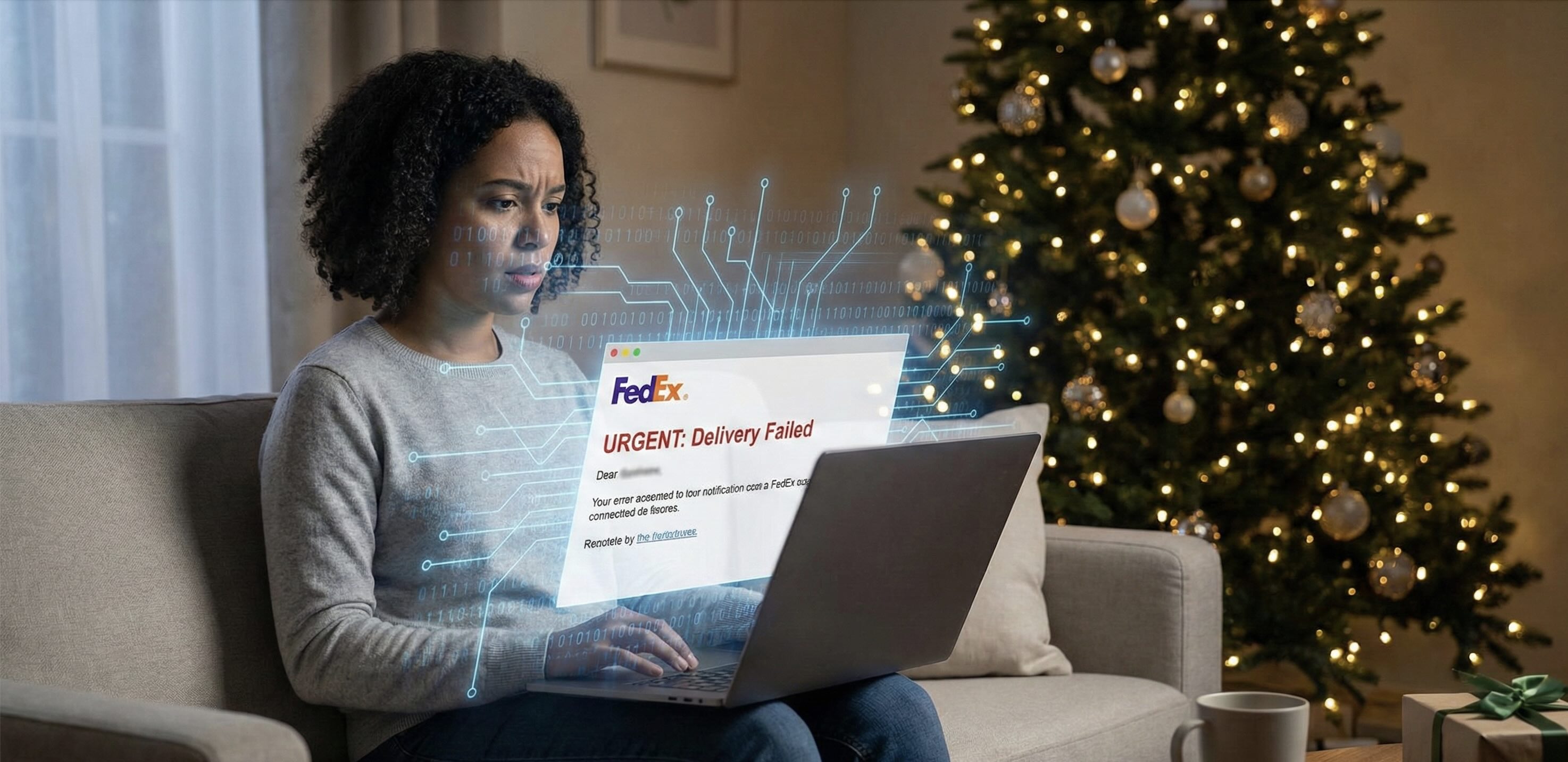
- "Failed Delivery" texts: Don't click the link; check the official FedEx/UPS app.
- "HR Holiday Bonus" emails: If it asks for a login, verify with HR first.
- "Order Confirmation" emails: Don't call the number included; check your account directly.
- Deepfake social ads: Be wary of ads asking you to download "coupon tools" to get a deal.
- "Urgent Account Locked" alerts: Always go to the website manually.
Rule of thumb: If it feels urgent, pause. Verify before you click.
Why "Good Grammar" No Longer Means Safe
Let’s get the obvious one out of the way first: No, your CEO does not need you to urgently drive to Walgreens to buy $500 in Apple gift cards. If they do, you probably need a new CEO.
But while we laugh at the "gift card" scams of the past, the threats hitting inboxes this week aren't a joke.
Black Friday isn't just a day anymore; it's a season. Retailers began rolling out "Early Access" deals in late October, and cybercriminals followed suit immediately. We are already seeing a massive spike in phishing traffic this month as attackers look to capitalize on the early shopping chaos.
Historically, you could spot these scams by looking for pixelated logos or bad spelling. But in 2025, the game has changed.
With Generative AI, hackers are creating campaigns that are earlier, faster, and indistinguishable from reality. Here are the 5 specific AI-powered threats we are seeing spike right now—and why they matter to your security posture.
1. The "Failed Delivery" Smishing (SMS Phishing)
The Scam:You receive a text message: "USPS: We attempted to deliver your package [ID: 9201] but the address was incomplete. Please update delivery instructions here."
The AI Twist:In the past, clicking the link led to a generic, poorly made form. Now, scammers use AI coding assistants to generate sophisticated, mobile-responsive landing pages that look identical to the real FedEx, UPS, or USPS tracking portals.
The Corporate Risk:If this occurs on a BYOD (Bring Your Own Device) phone that has MFA authenticator apps installed, a compromised mobile browser can act as a gateway to capturing session cookies or intercepting 2FA codes.
2. The Deepfake Ad & The "Drive-By" Download
The Scam:Your employee is on their lunch break, scrolling TikTok or Instagram on their work laptop. They see a video of a famous tech YouTuber—or a celebrity like Taylor Swift—recommending a "90% off" Black Friday deal on MacBooks.
The AI Twist:The video is a deepfake, but the real threat isn't just the lost money—it's the destination. These ads often direct users to "spoof" sites that prompt them to download a "Coupon Claimer" extension or a "Secure Shopping Browser."
The Corporate Risk:The moment the employee clicks "Download" to get the deal, they are often installing an Infostealer or a Remote Access Trojan (RAT) directly onto the corporate endpoint. Since the device is already authenticated to your network, the malware can bypass perimeter defenses.
3. The "HR Holiday Bonus" Spear Phishing
The Scam:You receive an email that looks like it came from your internal HR platform (e.g., Workday or Gusto). It references your company's actual recent wins ("Great job on Q3!") and offers a link to select your "Annual Holiday Gift."
The AI Twist:Attackers scrape public data from LinkedIn to identify your company’s organizational structure. They feed this data into an LLM to draft an email that perfectly mimics the tone of your actual executives. Because the AI writes with high corporate fluency, the usual "awkward phrasing" triggers in your brain don't go off.
The Corporate Risk:This is a direct Credential Harvesting attack aimed at gaining SSO (Single Sign-On) access to your HR and payroll systems.
4. The "Rogue Support Agent" Chatbot
The Scam:You order a gift, but it hasn't arrived. You Google the retailer's support number, find a "Live Chat" link on a third-party site, and start typing.
The AI Twist:You aren't talking to a human or a "dumb" bot. You are talking to a malicious AI trained to be polite and empathetic. It is programmed to extract your credit card information "to process the refund" or "verify your identity."
The Corporate Risk:Sophisticated bots often convince users to download "Remote Support Tools" (like AnyDesk or TeamViewer) to "help fix the transaction," inadvertently granting a threat actor remote control over a corporate device.
5. The "Panic Purchase" Confirmation
The Scam:You get an email receipt from PayPal or Amazon confirming a purchase of a $2,500 Gaming Monitor that you definitely didn't buy. The email says: "If you did not authorize this, call our fraud team immediately at [Phone Number]."
The AI Twist:The goal is to get you on the phone. The receipt is an AI-generated PDF that passes visual inspection. When you call, you are connected to a call center (using AI voice changers) that will guide you to "download remote software" to fix the glitch.
The Corporate Risk:This is a textbook "Vishing" (Voice Phishing) attack. By getting the employee on the phone, the attacker builds trust and convinces them to install Remote Access Software. This grants the attacker full control over the corporate endpoint, often bypassing EDR tools because the user installed the software "voluntarily."
How to React: Your Immediate Defense Plan
These scams are designed to trigger an emotional response—fear, excitement, or urgency. Here is how to lock down your security posture for the next few weeks:
- MFA Everything: Ensure Multi-Factor Authentication is enabled on all your accounts. It is your last line of defense if you accidentally give up a password.
- The "3-Second Pause": When you feel an emotional reaction to a message, force yourself to wait 3 seconds before clicking.
- Verify the Source: Never click a link in an "Order Confirmation" email. Always open the retailer's app directly to check your order history.
- Report, Don't Hide: If you accidentally click a link on your work device, tell IT immediately. Speed is critical to stopping a breach.
Black Friday is just the beginning. The use of AI in cyberattacks is projected to increase by 300% in the next 12 months. Scammers are refining their tactics daily. Is your organization ready for what’s coming in Q1?
[Download the 2025 Threat Report] to see the full forecast of AI-driven cybersecurity trends and how to prepare your defense.