Email Security
Technical Guides
Technical Reference: The Architecture of Google Workspace and Microsoft 365 Email Security (Beyond the Defaults)
The Engineering Behind the Defaults: SPF, DKIM, and DMARC Failure Modes Explained


Companion to: A Practical Guide to Microsoft 365 Email Security & Google Workspace Hardening Against AI-Generated Phishing
Modern email security still hinges on three authentication protocols: SPF, DKIM, and DMARC. Your parent configuration guide is the click-by-click “what to set.” This document is the “why it works,” plus the failure modes and forensics you need when something breaks (deliverability issues, false positives, spoofing reports, vendor mail, forwarding, mailing lists).
Email spoofing persists because SMTP was designed without strong sender identity verification. Attackers exploit that gap in Business Email Compromise (BEC) and higher-quality phishing, including LLM-written messages that look clean enough to slip past content-only filters. The baseline defense is still identity verification and policy enforcement using native protocols.
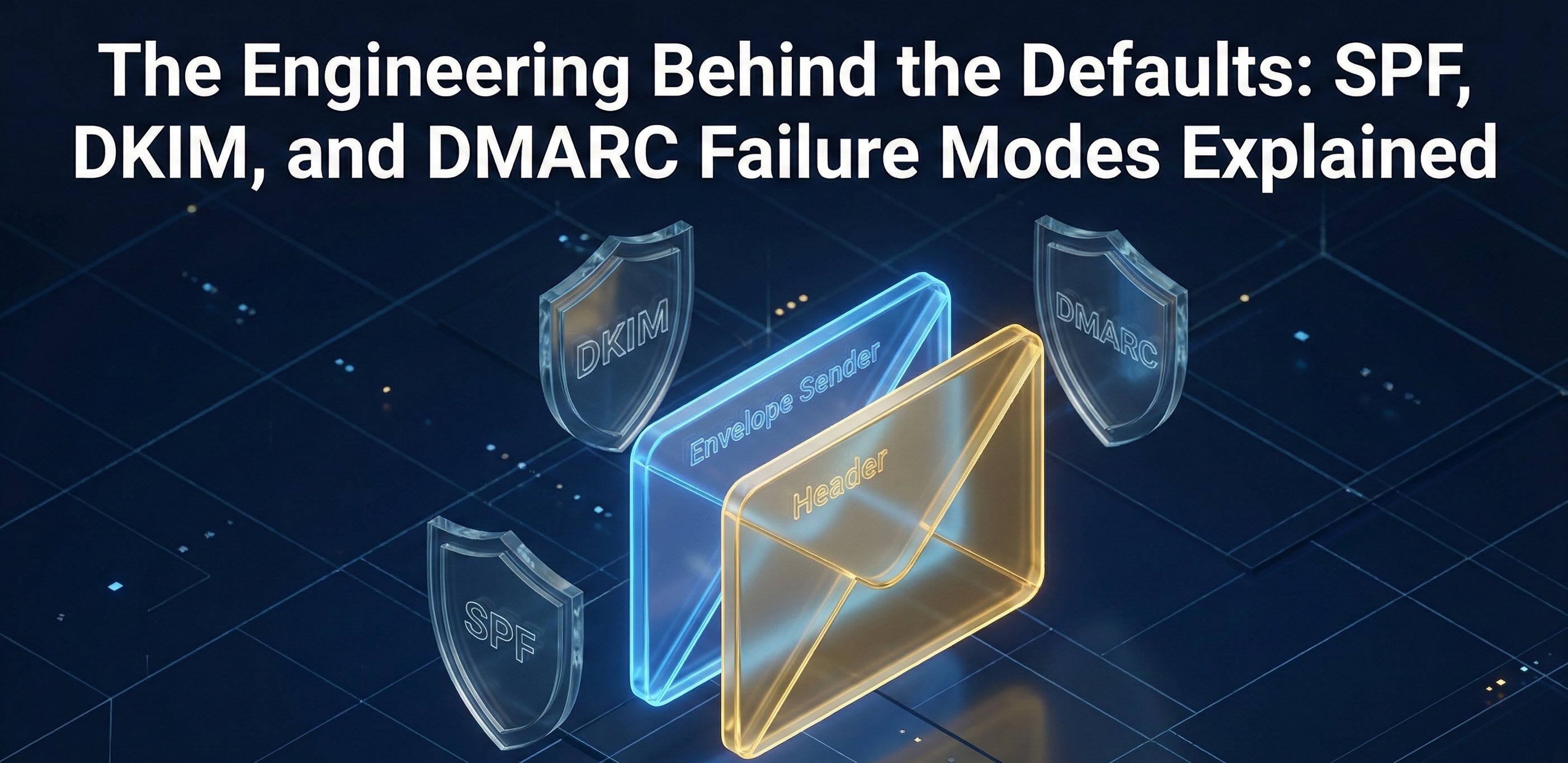
To understand why authentication passes while users still get spoofed, you need to separate the two “sender” identities in every email.
Also called MAIL FROM or Return-Path. This is used by mail servers during transmission (bounces, routing). End users typically do not see it.
SPF evaluates the envelope sender domain.
This is the visible From: address in Outlook, Gmail, and most clients.
DMARC protects the header From domain.
Attackers exploit the mismatch. Example:
[email protected] (they control this domain and its SPF)[email protected] (what the user sees)If you only validate SPF without enforcing alignment, the attacker can pass SPF for their own domain while impersonating yours in the visible header.
RFC: 7208
SPF is an IP authorization check. It answers:
“Is this IP allowed to send mail for this domain (as defined by the envelope sender)?”
p4 / ip6: Explicit IP ranges. Efficient and predictable.include: Authorizes third-party senders (example: include:_spf.google.com).all: Catch-all at the end. Usually paired with -all or ~all.Failure mode A: The 10-lookup limit
SPF limits DNS lookups to 10. Too many include statements or nested includes can trigger a PermError, which many receivers treat as a fail.
Failure mode B: Forwarding breaks SPF
SPF validates the last hop IP. If mail is forwarded, the sending IP changes to the forwarder. If the forwarder is not authorized in the original sender’s SPF, SPF fails even for legitimate mail.
Practical takeaway: SPF is useful, but it is brittle in forwarded and list-served paths. You need DKIM and DMARC to get consistent outcomes.
RFC: 6376
DKIM adds a cryptographic signature to the message. It proves:
When troubleshooting, find DKIM-Signature: and pay attention to:
d= (domain): the signing domain (important for DMARC alignment)s= (selector): points to the public key in DNSh= (headers): which headers are covered by the signaturebh= (body hash): the body content hashDKIM can fail when intermediaries modify the message. Common causes:
Oversigning is a technique to prevent attackers from adding extra headers to an otherwise validly signed message.
How it works: you list a header more times in h= than it appears in the message, for example:
h=From:From:To:SubjectThat asserts “there is only one From header,” so attempts to inject another can break signature verification.
Use this when you need stronger guarantees against header manipulation and you understand the compatibility tradeoffs.
RFC: 7489
DMARC is the policy and enforcement layer. It resolves the envelope/header mismatch by requiring identifier alignment.
DMARC passes only if:
Practical takeaway: alignment is what makes DMARC effective against “looks internal” spoofing and CEO fraud.
p=none is monitoring only. It does not block spoofing. Receivers can log failures and still deliver messages.
If you want protection, you need an enforcement posture (typically staged):
Note: rollout needs vendor inventory and testing. This is why the DMARC rollout deserves its own playbook.
When someone reports a spoof or a message is blocked unexpectedly, start with the receiver’s Authentication-Results header (naming varies by platform). It summarizes SPF/DKIM/DMARC outcomes.
Authentication-Results: mx.google.com;
spf=pass (domain of [email protected] designates 1.2.3.4 as permitted sender)
dkim=pass [email protected];
dmarc=fail (p=reject) header.from=bank.com
What happened
evil.com (attacker controls the sending infrastructure)evil.com (attacker signed with their key)Verdict
DMARC blocks or quarantines based on policy, preventing a clean spoof from reaching users.
Authentication-Results: protection.outlook.com;
spf=fail (sender IP is 5.6.7.8)
dkim=fail (body hash did not verify)
dmarc=fail
What happened
Verdict
This is a common cause of false positives and “why did this vendor suddenly fail?” tickets.
ARC (Authenticated Received Chain) can preserve authentication context across forwarding and list flows. If your environment relies heavily on forwarding or listservs, ARC is often the cleanest path to reduce breakage while keeping enforcement strict.
ARC is not a replacement for SPF/DKIM/DMARC. It is a way to carry forward verifiable authentication results through intermediaries.
Security teams often use swaks (Swiss Army Knife for SMTP) to simulate scenarios. Only test in environments where you have permission and you understand the impact.
swaks --to [email protected] --from [email protected] --server 1.2.3.4
Interpretation: checks whether 1.2.3.4 is authorized to send for example.com based on SPF.
swaks --to [email protected] \
--from "CEO <[email protected]>" \
--h-From: "CEO <[email protected]>" \
--envelope-from [email protected] \
--server mail.target.com
Interpretation: tests whether the receiving environment enforces DMARC alignment when the envelope and header sender domains differ.
Q: Can DMARC replace a Secure Email Gateway (SEG)?
A: DMARC can eliminate a large portion of spoofing and impersonation risk when it is enforced correctly and your sender ecosystem is clean. It does not replace link and attachment analysis, detonation, advanced phishing detection, or post-delivery remediation. Many orgs get meaningful risk reduction by maximizing native controls first, then evaluating what gaps remain.
Q: Why does SPF fail even though my IP is listed?
A: The most common cause is forwarding. SPF validates the last hop IP, not the original sender’s infrastructure. If mail is forwarded or passed through a list, SPF often fails even when the original sender is legitimate. DKIM is usually more resilient, and DMARC can pass if aligned DKIM passes.
Q: How does DMARC stop CEO fraud (BEC)?
A: CEO fraud relies on making the visible From address look internal. DMARC requires that the authenticated domain aligns with the Header From domain. If an attacker spoofs your domain, the message fails alignment and can be blocked by policy.
Q: What is the SPF 10-lookup limit?
A: SPF restricts DNS lookups to 10 to prevent abuse. Complex vendor ecosystems can exceed this through nested include records, causing PermError outcomes that weaken authentication.
Q: Is “AI phishing” different from standard phishing?
A: The delivery mechanics are the same, but the content quality is higher and less dependent on known signatures. That shifts defenders toward stronger identity verification (SPF/DKIM/DMARC), policy enforcement, and behavioral indicators instead of relying only on text-based detection.